

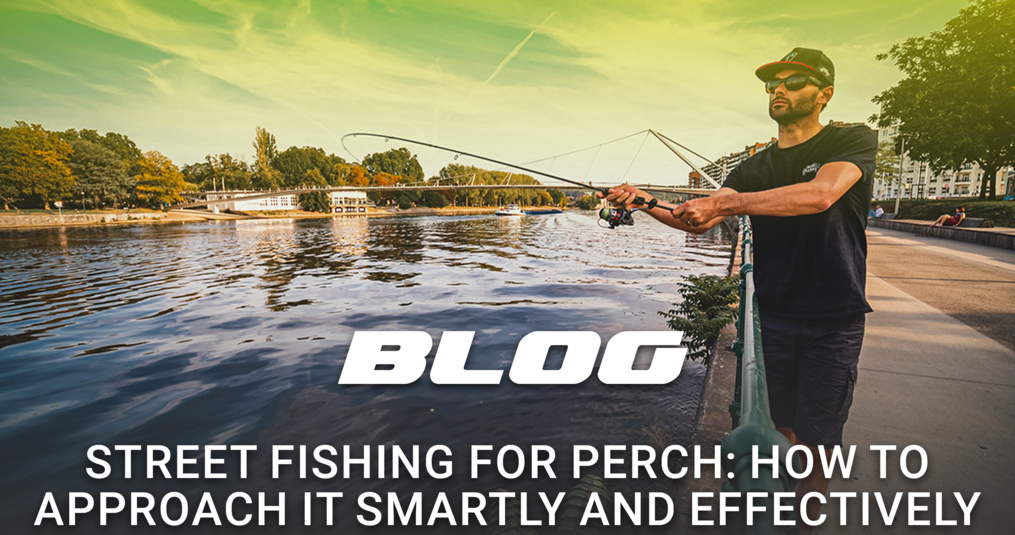
In this blog you’ll learn what street fishing actually is, how to approach it as a beginner, and which techniques and equipment make the difference when fishing for perch.
Street fishing has quickly grown into one of the most popular ways of targeting predatory fish in the Netherlands. And that makes sense. You need very little gear, almost every city offers opportunities, and your chances of catching good numbers of perch are very real. Especially for anglers who prefer an active style of fishing and don’t want to sit in one spot for hours, this is the ideal way to cover water.
What is street fishing
Street fishing means fishing with light tackle in urban waters. Think of canals, city harbours, locks, bridges, and river sections in or around the city. The main targets are predatory fish such as perch, zander and pike.
Mobility is key. You move from spot to spot and only fish the areas that look promising. Long stretches without structure are usually better skipped. The focus is on locations where predatory fish are likely to hold:
- Bridges and bridge pillars
- Locks and pumping stations
- Harbour entrances
- Transitions between still and flowing water
- Shaded areas along quays
- Moored boats
Perch feel surprisingly at home in urban waters. The combination of stone embankments, shelter, food and often slightly warmer water makes cities an ideal habitat. Smaller perch are often found right in the city centre, for example in canals and city harbours. Larger specimens are more often found closer to open water or river sections.
Street fishing is active. You keep moving and try to fish as many interesting spots as possible in a short time. That makes it dynamic and very educational.
Tips for street fishing for perch
If you are just starting out, it helps to fish in a structured way.
Start at clear hotspots
Bridges, locks and harbour entrances often produce fish quickly. These spots are heavily fished, but ideal for learning to recognise bites and developing technique.
Don’t stay too long
No action after ten minutes and you’ve fished the spot thoroughly? Move on to the next one. Active perch usually respond quickly. Forcing inactive fish is difficult, especially for beginners.
Fish tight to structure
Perch hunt from cover. Cast as close as possible to bridge pillars, quay walls, stairs and moored boats. The first meter next to obstacles is often decisive.
Pay attention to the current
In flowing water, perch often hold just outside the main current. There they conserve energy while food drifts past naturally.
Fish small for more action
Soft baits under 10 centimetres usually generate more bites. When starting out, frequent action teaches more than waiting for a single big fish.
Check where fishing is allowed
Make sure you have a valid fishing licence and check in the VisPlanner app whether fishing is permitted in the water you want to fish.
Techniques for street fishing for perch
Many techniques work, but two stand out for street fishing.
Dropshot
Dropshotting is the most accessible technique for beginners. The setup consists of a weight at the end of the line and a hook positioned about 20 to 40 centimetres above it, standing perpendicular to the line. The soft bait hangs horizontally above the bottom.
How to fish it:
- Cast to a promising spot.
- Let the weight sink to the bottom.
- Tighten the line and maintain constant contact with the weight.
- Slowly drag the weight a short distance.
- Pause briefly.
Keeping the line tight is crucial. Perch can bite extremely subtly. If you feel a tap or slight resistance, set the hook immediately. Doubt often means a fish.
The big advantage of dropshot is control. You can keep the bait in the strike zone for a long time, exactly where perch are feeding.
Jigging
Once you are comfortable with dropshotting, jigging is a logical next step. In this technique you fish a shad on a jig head.
How to fish it:
- Cast and let the shad sink to the bottom.
- Tighten the line.
- Give a short upward twitch with the rod.
- Let the shad sink back to the bottom in three to four seconds while keeping the line tight.
Most bites occur during the sinking phase. Again, keep the line tight and react immediately. Experimentation pays off. Water colour, light conditions and fish activity determine what works best.
Gear for street fishing for perch
Good gear makes street fishing more efficient and enjoyable. You fish actively, walk a lot and often deal with hard quays and underwater obstacles. Below is what to look for in each piece of equipment, with product examples that fit street fishing for perch.
Rod
An all-round spinning rod up to about 2.20 metres with a casting weight around 10–20 grams is ideal for urban fishing. Good examples that are very suitable for street fishing are the SPRO Specter Finesse, Shimano Zodias and Westin W6 Streetstick. These rods are known for their sensitive tips and fast actions, allowing you to detect subtle perch bites and respond instantly. A responsive blank ensures solid hooksets, while the sensitive tip helps detect even the smallest taps. Especially with finesse techniques such as dropshotting and light jigging, this is a major advantage. Choose a light spinning rod with plenty of sensitivity, because bite detection is often the difference between missing and landing fish.
Reel
Pair your rod with a light reel in size 1000 or 2500. Good balance is important, especially if you spend hours walking and casting. A smooth drag system and good line lay give maximum control during the fight. Excellent options include the Westin W2, Westin W3 and Shimano Vanford. These reels work perfectly with light braided lines and match the active nature of street fishing.
Line and leader
For street fishing it’s best to use thin braided line of about 0.08–0.12 mm. This provides direct contact with your lure and maximum bite detection, which is essential when fishing for subtle perch in urban waters. Good choices include the MoiMoi Ryujin, Westin W10 Cast ‘N’ Jig and YGK Bornrush. Combine this with a strong fluorocarbon leader of 0.25–0.35 mm to handle abrasion from stones, bridge pillars and other obstacles, because in urban waters, obstacles are more the rule than the exception.
Lures
Shads under 10 centimetres form the foundation of street fishing for perch. Combine them with appropriate jig heads or fish them on a dropshot rig for maximum bite detection. For variation you can also use creature baits, twitchbaits and small crankbaits. A varied selection in both natural and bright colours gives you flexibility in changing conditions.
Landing net
In many cities you fish from high quays. A landing net with a longer handle is therefore not a luxury but a necessity. Choose a compact, foldable predator net that is easy to attach to your bag.
Unhooking tools and accessories
A solid pair of pliers and a compact unhooking mat should always be in your bag. In urban environments fish easily end up on stone or concrete, which you want to avoid. Compact pliers, measuring tapes and foldable unhooking mats take up little space but make a big difference in handling fish carefully.
With this basic setup you can street fish for perch efficiently, responsibly and with maximum mobility. Keep things simple, choose your gear carefully and make sure everything works well together. Not only does that fish more comfortably, it is also demonstrably more effective.